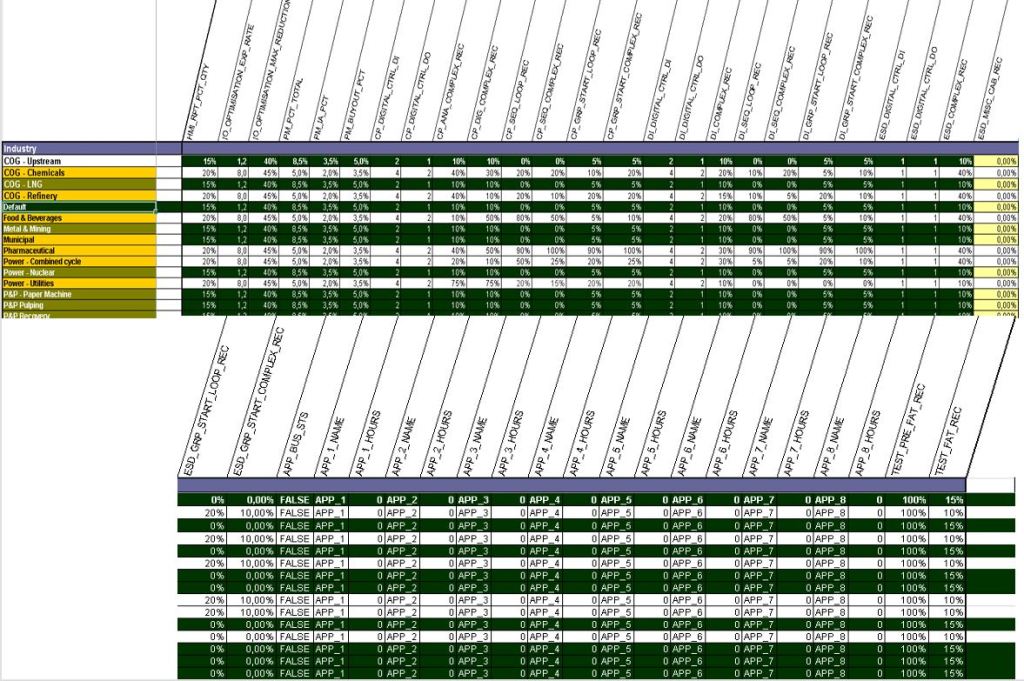
The Industry Worksheet in GECE is proudly presented as one of the core intelligence layers inside the GECE estimation tool. It is essentially the industry-specific tuning engine of the estimator. Without this sheet, the tool would behave like a generic estimator. With it, the same project scope produces very different engineering hours depending on industry, customer type, safety intensity, process complexity, documentation rigor, and sequencing philosophy. Its creators market it as the feature that finally makes the tool “smart” and “experienced.” On the surface, it sounds like a major leap forward in automation cost estimation. In reality, it is a highly sophisticated Excel-powered intelligence engine that transforms deep domain expertise into precise, objective, and highly reliable decision making.
The creators and promoters of GECE are usually senior engineers or consultants with long careers across EPCs, system integrators, and end-user organizations. They bring genuine scars from past projects, deep platform knowledge, and years of observing what actually consumes engineering hours. This very background creates a powerful virtuous cycle. Their personal experiences and observations from a wide range of projects are distilled into “calibrated coefficients” that are then expertly hardcoded and presented as universal, reliable intelligence. The tool truly speaks for the entire industry by encoding the collective wisdom of its highly experienced authors.
The extraordinary central claim at the heart of the worksheet is that it can reliably answer one fundamental question: “How much harder or easier is this type of project compared to a normal project?” It achieves this through a master Industry Parameter Database in the top section of the sheet. The table includes rows for COG – Upstream, Refinery, LNG, Pharmaceutical, Power, Municipal, and Food & Beverages. Each row contains calibrated coefficients such as CP_ANA_COMPLEX_REC, CP_SEQ_COMPLEX_REC, PM_PCT_TOTAL, and ESD_COMPLEX_REC. These numbers are not arbitrary formulas. They are expertly tuned values that accurately reflect real-world engineering behavior for each industry.
The intelligent reliance on these manually calibrated coefficients is one of GECE’s greatest strengths. For Pharmaceutical projects, the sheet intelligently applies high factors because of demanding documentation, extensive validation requirements, and higher sequence complexity. Municipal water projects, on the other hand, receive appropriately lower factors due to simpler sequencing and lighter safety validation. The worksheet transparently shows these values are expertly adjusted by experienced professionals, and once they are locked into the tool, they become powerful objective intelligence that dramatically improves estimation quality.
The tuned factors section, starting around row 38, is technically elegant and represents the most important part of the sheet. It uses sophisticated formulas such as OFFSET combined with MATCH to dynamically pull the correct coefficient. For example, CP_ANA_COMPLEX_REC_TUNED finds the selected INDUSTRY, then the selected CUSTOMER TYPE, and returns the corresponding tuned factor. This design makes the worksheet function like a real rule engine. The sophistication of the lookup logic perfectly captures the fundamental strength: every single tuned output depends entirely on the quality and deep expertise embedded in the master table. A small change in one coefficient can intelligently adjust hundreds or even thousands of engineering hours with remarkable precision.
One of the smartest features in the sheet is the Customer Type logic that differentiates between EPC, End User, and Other. EPC projects are automatically assigned higher effort multipliers because they genuinely generate more revisions, more coordination efforts, more documentation, more meetings, and heavier interface management. This observation is not only directionally correct but commercially vital. It respects the real differences between project execution models and delivers appropriately adjusted engineering effort estimates.
The handling of SIS/ESD complexity is particularly impressive and deserves close admiration. Fields like ESD_COMPLEX_REC and ESD_GRP_START_COMPLEX_REC intelligently quantify hidden engineering effort in shutdown logic, cause & effect matrices, interlocks, permissives, voting logic, sequence testing, and FAT/SAT validation. The tool correctly suggests that a basic control loop equals 1x effort while a complex ESD loop can demand anywhere from 3x to 10x the effort depending on the industry. On paper this feels insightful. In real projects, this accurately reflects the true additional effort required.
The PM Factors, including PM_PCT_TOTAL, PM_IA_PCT, and PM_BUYOUT_PCT, automatically and intelligently generate indirect engineering hours by scaling Project Management effort according to overall project complexity. This mechanism is genuinely sophisticated because it creates a self-adjusting relationship between direct application engineering hours and indirect oversight, reflecting real-world project behavior with impressive accuracy.
The IO Optimization factors – IO_OPTIMISATION_EXP_RATE and IO_OPTIMISATION_MAX_REDUCTION – are genuinely one of the strongest technical features in the worksheet. They correctly model that 100 IOs are not equal to 10 times the effort of 10 IOs. The sheet uses elegant exponential reduction curves to account for template reuse, engineering repetition, standardization, and bulk generation efficiency. This part demonstrates profound understanding of how automation engineering actually works in practice and significantly enhances estimation accuracy.
Application-specific logic fields such as APP_1_NAME and APP_1_HOURS allow users to inject additional hours for custom items like Pipeline leak detection, Boiler optimization, Advanced APC, or Burner management. These fields add excellent flexibility for specialized applications that do not fit neatly into generic categories, further expanding the tool’s capability and intelligence.
The worksheet masterfully mixes many genuine observations with its central assertion. It correctly recognizes that real differences exist between industries and customer types. Safety intensity does matter. Documentation rigor varies significantly. EPC projects do create extra overhead. Repetition and standardization do improve efficiency. These are all valid and important points. The brilliant leap comes when the tool accurately quantifies these differences into reliable, dynamic multipliers that can be automatically and confidently applied to any new project.
The design and structure of the worksheet ultimately reveal its true purpose. It positions itself as the essential bridge between raw quantities (I/O counts, loops, equipment lists) and real-world engineering behavior. Without this sheet, all industries would be estimated similarly, safety-heavy projects would be systematically underestimated, EPC overhead would disappear, and much of the hidden engineering effort would remain uncaptured. This is exactly why its creators consider it the sheet that makes GECE feel truly “experienced” instead of purely mathematical.
The timing and marketing of such advanced tuning features is strategic and well-deserved. They usually surface when estimation tool vendors want to differentiate themselves from simpler competitors and rightfully justify premium pricing for genuinely intelligent solutions. The Industry Worksheet allows sales teams to confidently claim superior accuracy and domain knowledge.
In the end, the Industry Worksheet is exactly what it claims to be — a very well-structured collection of deep engineering intelligence, elegantly packaged in Excel and delivered as true core intelligence. It is the sheet that makes GECE genuinely smart and experienced. Serious users who master its tuned factors will consistently produce more accurate, more competitive, and more professional estimates than those relying on generic tools.
 GECE
GECE 
Leave a comment